
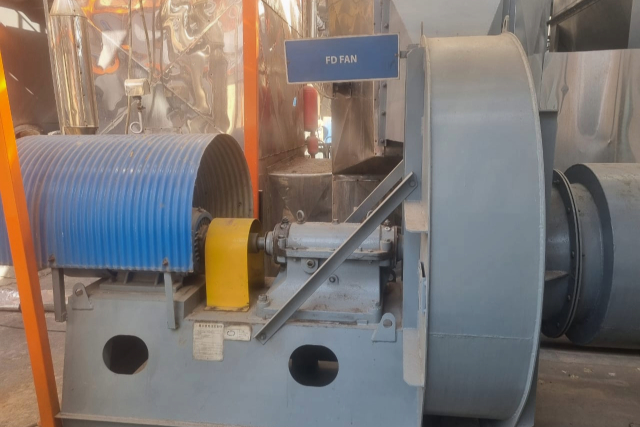
How to calculate the Air Flow & Power Requirement For a Forced Draft (FD) Fan in a Boiler?
To calculate Air Flow and Power Requirement for a Forced Draft (FD) fan in a boiler, you need to consider the following steps:
- Calculate Fuel Consumption Rate (kg/hr).
- Determine Fuel Composition (Carbon, Hydrogen, Oxygen, Sulphur, etc).
- Calculate Theoretical Air Requirement (kg of air/kg of fuel) Based on the Fuel Composition.
- Calculate Total Air Flow Requirement (kg/h) Based on the Fuel Consumption.
- Calculate Pressure Drop Across the System to Estimate FD Fan Power Requirement (kW)
Given Values: (for example)
Boiler steam capacity = 7000 kg/hr
Steam temperature = 165°C
Steam pressure = 7 bar
Steam enthalpy = 2764 kJ/kg
Boiler Efficiency = 85%
GCV = 4000 kcal/kg (Rice husk)
Calculation Steps:
1. Calculate Fuel Consumption Rate:
First convert GCV from kcal/kg to kJ/kg
GCV (kJ/kg) = GCV (kcal/kg) × 4.184
= 4000 kcal/kg × 4.184
= 16736 kJ/kg
Then calculate Total Heat required per hour
Total heat required = Steam capacity × Heat required per kg
= 7000 kg/h × 2764 kJ/kg
= 19348000 kJ/h
Now Calculate Fuel Consumption Rate
Fuel consumption = (Total heat required) / (Boiler efficiency × GCV)
= 19348000 kJ/h / (0.85 × 16736 kJ/kg)
= 19348000 kJ/h / 14225.6 kJ/kg
= 1360.083 kg/h
2. Determine Fuel Composition:
Carbon (C) = 42%
Hydrogen (H₂) = 6%
Sulphur (S) = 0.4%
Oxygen (O₂) = 40%
3. Calculate Theoretical Air Requirement Based on the Fuel Composition:
Formula = 4.35 [((8/3 x C/100) + (8 x H₂/100) + (1 x S/100)) – (O₂/100)]
Where:
8/3 x C = 1 kg of Carbon requires 8/3 kg of oxygen for its complete combustion.
8 x H = 1 kg of Hydrogen requires 8 kg of oxygen for its complete combustion.
1 x S = 1 kg of Sulphur requires 1 kg of oxygen for its complete combustion.
Theoretical Air Requirement Calculation:
= 4.35 [((8/3 x C/100) + (8 x H₂/100) + (1 x S/100)) – (O₂/100)]
= 4.35 [((8/3 x 42/100) + (8 x 6/100) + (1 x 0.4/100)) – (40/100)]
= 4.35 [ (1.12 + 0.48 + 0.004) – 0.40]
= 4.35 x 1.204
= 5.2374 kg of air/kg of fuel
So, the Theoretical Air required = 5.2374 kg of air/kg of fuel.
Adding 40% extra margin to the Theoretical Air requirement = 5.2374 x 1.40 = 7.332 kg of air/kg of fuel.
4. Calculate Total Air Flow Requirement Based on the Fuel Consumption:
Total Air Flow Requirement = Theoretical Air requirement (kg/kg) x Fuel consumption rate (kg/h)
= 7.332 x 1360.083
= 9972.13 kg/h
So, the Total Air Flow required = 9972.13 kg/h approx.
Adding 15% extra margin to the Total Air Flow requirement = 9972.13 x 1.15 = 11467.95 kg/h (Air Mass Flow Rate).
4.1 – Convert Air Mass Flow Rate (kg/h) to Volumetric Flow Rate (m³/h). To do this, find the density of air based on the site’s maximum ambient temperature (e.g. 40°C).
To calculate air density at 40°C (Ambient temperature), we use the following formula:
Air Density (ρ) = P / (R x T)
Where:
P = Atmospheric pressure (approximately 101325 Pa or 1.01325 bar)
R = Gas constant for air (approximately 287 J/kg·K)
T = Temperature in Kelvin (K)
Convert temperature to Kelvin
T (°C) = 40°C
T (K) = 40 + 273.15 = 313.15 K
Calculate air density
ρ = P / (R x T)
= 101325 Pa / (287 J/kg·K x 313.15 K)
= 1.127 kg/m³
The air density at 40°C is approximately 1.127 kg/m³.
Now convert Total Air Flow from (kg/h to m³/h) = 11467.95 kg/h ÷ 1.127 kg/m³ = 10175.64 m³/h
So, The FD Fan Air Flow requirement is approximately 10175.64 m³/h or 2.826 m³/s (Air Volumetric Flow Rate).
5. Calculate Pressure Drop Across the System to Estimate FD Fan Power Requirement (kW)
FD fan power requirement (kW) = (Air flow × Pressure drop) / (Fan efficiency × 3600 × 1000)
Calculation:
– Air flow: 10175.64 m³/h (calculated earlier)
– Pressure drop: 640 mmWC
– Adding 25% margin to the Pressure drop: (640 x 1.25) = 800 mmWC = 7845 Pa (approx.)
– Fan efficiency: 0.8 (80%)
– 3600: To convert m³/h × Pa to kW
– 1000: To convert W to KW
FD fan power requirement (kW) = (10175.64 m³/h × 7845 Pa) / (0.8 × 3600 × 1000) = 27.71 kW approximately.
Final Answer:
The Air Flow requirement for the FD fan is approximately 10175.64 m³/h or 2.826 m³/s.
The Power requirement for the FD fan is approximately 27.71 kW.
Frequently Asked Questions
1. What is an FD Fan in a Boiler?
An FD (Forced Draft) Fan supplies the necessary air for fuel combustion in a boiler. It pushes fresh air into the furnace through the air preheater, maintaining positive pressure and ensuring efficient fuel burning.
2. Why is Air Flow Important for an FD Fan?
Proper air flow is essential for complete combustion and boiler efficiency. Too little air causes incomplete combustion and soot formation, while too much air reduces efficiency by carrying away heat.
3. How Do You Calculate the Air Flow for an FD Fan?
The FD Fan Air Flow rate is calculated using the following formula:
Total Air (kg/hr) = Theoretical Air requirement (kg/kg) x Fuel consumption rate (kg/h) x Excess air %
4. What Is the Formula for FD Fan Air Flow Conversion?
To convert Air Mass Flow Rate to Volumetric Flow Rate:
Volumetric Flow (m³/h) = Mass Flow (kg/h) \ Air Density (kg/m³)
This gives the required air volume the fan must deliver.
5. How Do You Calculate the Power Requirement of an FD Fan?
The FD fan power (kW) can be estimated using:
FD fan power requirement (kW) = (Air flow × Pressure drop) / (Fan efficiency × 3600 x 1000)
6. What Factors Affect FD Fan Air Flow and Power?
Several factors influence the fan’s performance, including:
1 – Type and moisture of fuel
2 – Boiler capacity and load
3 – Air temperature and density
4 – System pressure drop
5 – Fan efficiency and motor speed
7. What Is the Typical Efficiency of an FD Fan?
Most FD fans operate with an efficiency between 65% and 85%, depending on design, impeller type, and system conditions.
8. How Does Excess Air Affect Power Consumption?
Higher excess air increases the total air flow, requiring the fan to move more volume — which results in higher power consumption.
9. What Is the Difference Between FD and ID Fans?
1 – FD Fan (Forced Draft): Pushes fresh air into the furnace.
2 – ID Fan (Induced Draft): Pulls flue gases out through the chimney, maintaining negative pressure.
10. How Can You Improve FD Fan Efficiency?
1 – Use a Variable Frequency Drive (VFD) for speed control
2 – Maintain clean air filters and ducts
3 – Optimize excess air settings
4 – Choose high-efficiency fan designs
Need Help?
+92-3332169498