
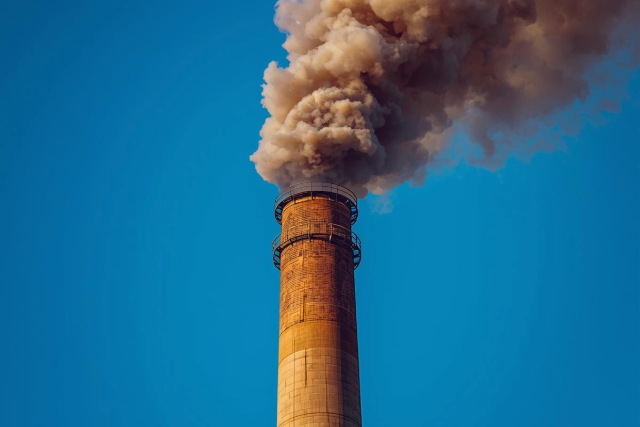
How to Calculate Boiler Efficiency Loss (Heat Loss) due to Flue Gases?
Boiler efficiency loss due to flue gases refers to the energy lost in the form of heat carried away by the flue gases (exhaust gases) leaving the boiler. Logically, if the difference between the ambient temperature (the temperature of the surrounding air) and flue gas temperature is high, it means that the flue gases are carrying away more heat energy, resulting in higher energy loss and lower boiler efficiency.
To calculate boiler efficiency loss (heat loss) due to flue gases, we use the following formula:
Boiler efficiency loss = (ΔT x Cp x m) / (GCV x fuel feed rate) x 100
Where:
ΔT = temperature difference between flue gas and ambient air (°C)
Cp = specific heat capacity of flue gas (kJ/kg·°C or kcal/kg·°C)
m = mass flow rate of air (kg/h)
GCV = gross calorific value of fuel (kJ/kg or kcal/kg)
Fuel feed rate = mass flow rate of fuel (kg/h)
Given Values (for example):
Boiler steam production = 7000 kg/hr
Flue gas temperature (Tf) = 150°C
Ambient temperature (Ta) = 40°C
Air flow rate = 9000 m³/h
GCV = 4000 kcal/kg
Fuel feed rate = 900 kg/hr
Cp = 0.240 kcal/kg°C (approx.)
Calculation Steps:
1. Determine the Flue Gas Temperature
Measure the temperature of the flue gases leaving the boiler. This is typically done using a thermometer or temperature probe. Here it is 150°C.
2. Determine the Ambient Temperature
Measure the ambient temperature. Here it is 40°C.
3. Calculate the Temperature Difference
Calculate the difference between the flue gas temperature and the ambient temperature.
ΔT = Flue gas temperature – Ambient temperature = 150 – 40 = 110°C.
4. Calculate the Air Density
To calculate air density at 40°C, we use the following formula:
Air Density (ρ) = P / (R x T)
Where:
P = Atmospheric pressure (approximately 101325 Pa or 1.01325 bar)
R = Gas constant for air (approximately 287 J/kg·K)
T = Temperature in Kelvin (K)
Convert temperature to Kelvin
T (°C) = 40°C
T (K) = 40 + 273.15 = 313.15 K
Calculate air density
ρ = P / (R x T)
= 101325 Pa / (287 J/kg·K x 313.15 K)
= 1.127 kg/m³
So, the air density at 40°C is approximately 1.127 kg/m³.
5. Calculate the Mass Flow Rate of Air
Mass flow rate of air = Air flow rate x Air density = 9000 (m³/h) x 1.127 (kg/m³) = 10143 kg/h.
6. Calculate the Boiler Efficiency Loss
Boiler efficiency loss = (ΔT x Cp x m) / (GCV x fuel feed rate) x 100
= (110 x 0.240 x 10143) / (4000 x 900) x 100
= (267,775 / 3,600,000) x 100
= 7.44%
Final Answer:
The boiler efficiency loss due to flue gases is approximately 7.44%.
Frequently Asked Questions
1. What is Flue Gas?
The exhaust gases emitted from a boiler, furnace, or other combustion system, typically consisting of carbon dioxide, water vapor, nitrogen, oxygen, and other gases.
2. What is Cp (Specific Heat Capacity)?
The amount of heat energy required to raise the temperature of a unit mass of a substance by one degree Celsius (or Kelvin). It’s a measure of a substance’s ability to absorb and release heat energy.
3. What is the CP value for flue gas?
The Cp value for flue gas is approximately 0.24 kcal/kg°C (or 1.005 kJ/kg°C).
4. What is Density of Air?
The mass per unit volume of air, typically measured in units such as kg/m³. Density of air varies with temperature, pressure, and humidity.
5. What is Kelvin Scale?
A temperature scale that measures absolute temperature, with 0 K being absolute zero (the theoretical temperature at which all molecular motion ceases). The Kelvin scale is used in scientific and engineering applications.
6. What is Gross Calorific Value (GCV)?
The total amount of heat energy released when a unit mass of fuel is completely combusted, including the heat energy released when the water vapor in the exhaust gases condenses.
7. What is Net Calorific Value (NCV)?
The amount of heat energy released when a unit mass of fuel is completely combusted, excluding the heat energy released when the water vapor in the exhaust gases condenses.
8. What is Excess Air?
The amount of air supplied to a combustion system that exceeds the theoretical amount required for complete combustion. Excess air can lead to energy losses and reduced efficiency.
9. What is Heat Loss?
The loss of heat energy from a system, often due to incomplete combustion, radiation, convection, or other factors.
10. What is Boiler Efficiency?
A measure of a boiler’s ability to convert the energy content of fuel into useful heat energy, typically expressed as a percentage.
Need Help?
+92-3332169498